If you’ve ever typed “what is digital marketing” into Google at 11 p.m. because your boss asked you to “own the digital strategy” by Monday, you’re not alone. It’s one of the most-searched business terms in the country, and yet most explanations either drown you in jargon or oversimplify it into a Wikipedia paragraph you forget in five minutes.
Here’s the short version, and then we’ll get into everything that actually matters.
Featured Snippet Answer
Digital marketing is the practice of promoting products, services, or brands through digital channels — search engines, social media, email, and paid advertising — to reach, engage, and convert a specific audience. Unlike traditional marketing (TV, print, radio), digital marketing is measurable in real time, which means you can see exactly what’s working and change course before you’ve burned your whole budget on it.
That one paragraph answers the question. Everything else in this guide is about what to actually do with that answer.
Key Takeaways
- “Digital marketing” is the umbrella term; online marketing and internet marketing sit underneath it, not next to it.
- There are eight core channels, and almost no business needs all eight at once — the right mix depends on your sales cycle and budget.
- The U.S. Small Business Administration recommends 7–8% of gross revenue for marketing, with fast-growth businesses pushing to 10–12%.
- A strategy without a measurement plan isn’t a strategy — it’s a guess with a budget attached.
- The biggest shift in 2026 isn’t a new platform. It’s that AI search (Google AI Overviews, ChatGPT, Perplexity) now answers questions before users click anything, which changes how content needs to be built to get cited at all. See our 2026 digital marketing trends breakdown for more on this.
Table of Contents
- What Is Digital Marketing? (Definition)
- Digital Marketing vs. Online Marketing vs. Internet Marketing
- Why Digital Marketing Matters Right Now
- The 8 Types of Digital Marketing
- How Digital Marketing Actually Works (4 Stages)
- B2B vs. B2C Digital Marketing
- Careers, Skills & Salaries
- Common Mistakes That Waste Marketing Budgets
- How to Build a Digital Marketing Strategy in 7 Steps
- Digital Marketing Tools Compared
- Agency vs. In-House: Which One Fits You?
- Expert Tips
- FAQs
- Conclusion
1. What Is Digital Marketing? (Definition)
Digital marketing is any marketing effort that uses an internet-connected device or a digital channel to reach an audience. That includes obvious things like a Google search ad or an Instagram post, but it also includes less obvious ones — a QR code on a coffee cup, a podcast ad read, a text message reminder about an abandoned cart.
The defining trait isn’t the channel. It’s the feedback loop. When a billboard goes up, you have no idea who saw it or whether it worked until sales data trickles in weeks later, filtered through a dozen other variables. When you run a digital ad, you know within hours how many people saw it, clicked it, and bought something because of it. That feedback loop is the entire reason digital marketing has eaten traditional marketing’s lunch over the last two decades — not because digital is inherently smarter, but because it’s accountable in a way print and broadcast never were.
AI Overview Answer Block: Digital marketing refers to the use of internet-based channels — including search engines, social platforms, email, and paid ads — to promote a business and connect with customers. It differs from traditional marketing primarily in measurability: every digital campaign generates trackable data on reach, engagement, and conversion, allowing marketers to adjust in real time rather than waiting for a campaign cycle to end.
2. Digital Marketing vs. Online Marketing vs. Internet Marketing
People use these three terms interchangeably, and honestly, in casual conversation, nobody’s going to correct you. But if you’re building a strategy, the distinction actually matters, because it tells you what’s in scope and what isn’t.
| Term | What It Covers | Example | Relationship |
|---|---|---|---|
| Digital Marketing | Any marketing on a digital device or channel, connected or not | A promoted TV ad, a digital billboard, an SMS campaign | The umbrella term — everything else sits inside it |
| Online Marketing | Marketing that specifically requires an internet connection | SEO, email marketing, social ads | A subset of digital marketing |
| Internet Marketing | Functionally identical to online marketing | PPC, content marketing | Used interchangeably with “online marketing” |
The practical takeaway: if someone hands you a “digital marketing strategy” and it only covers email and social, they’ve actually handed you an online marketing strategy. That’s fine — most small businesses don’t need digital billboards — but know the difference so you’re not confused when a bigger brand’s “digital strategy” includes things like connected TV ads that yours doesn’t.
3. Why Digital Marketing Matters Right Now
You don’t need convincing that people are online — you already know that. What’s worth understanding is why digital specifically outperforms traditional marketing on the metrics that keep a business alive.
It’s cheaper to test. A regional TV spot can run $50,000 for a single flight. A Google Ads test with the same learning value might cost $500. That difference means a small business can afford to be wrong five times before finding what works — something that was financially impossible in the print-and-broadcast era.
It’s precisely targetable. Traditional advertising targets a zip code or a time slot. Digital advertising can target a 34-year-old who searched “best running shoes for flat feet” in the last 48 hours and lives within 10 miles of your store. That precision is why digital cost-per-acquisition tends to run lower than traditional CPA across nearly every industry benchmark.
It’s adjustable mid-flight. If a print ad has a typo, you’re stuck with it until the next print run. If a digital ad underperforms, you can pause it in ninety seconds.
Cost Comparison: Digital vs. Traditional Marketing
| Factor | Digital Marketing | Traditional Marketing |
|---|---|---|
| Typical entry cost | Low ($100s–$1,000s to start) | High ($10,000s minimum) |
| Measurability | Real-time, granular | Delayed, aggregate |
| Targeting precision | Individual/behavioral | Broad demographic/geographic |
| Ability to adjust mid-campaign | Immediate | Not possible once published/aired |
| Typical timeline to see data | Days | Weeks to months |
None of this means traditional marketing is dead — a well-placed billboard still builds brand awareness digital can’t replicate. But for most businesses reading this, especially small and mid-sized ones, digital is where the budget should start.
4. The 8 Types of Digital Marketing
This is the section people actually bookmark. Each channel does a different job — treating them as interchangeable is the single most common strategic mistake we see. Adzine manages all eight of these for clients; see the full breakdown on our services page.
Search Engine Optimization (SEO)
SEO is the practice of improving your website so it ranks organically — meaning unpaid — in search results. It’s slow (expect 4–6 months before meaningful traffic) but it compounds. A well-optimized page can keep generating traffic two years after you published it, with zero ongoing spend. Explore our SEO services if you’d like this handled for you.
Search Engine Marketing / PPC (Google Ads)
Pay-per-click advertising puts you at the top of search results instantly, but you pay for every click. It’s the fastest way to test demand for a product before investing in slower channels like SEO. Our team runs PPC advertising campaigns built around your target cost-per-acquisition.
Social Media Marketing (Meta, LinkedIn, TikTok)
This splits into organic (posting content for free) and paid (running ads). Organic builds community; paid drives immediate reach. Most brands need both, in different ratios depending on whether they’re B2C (heavier on organic/community) or B2B (heavier on LinkedIn paid). See how we approach Meta Ads campaigns for Facebook and Instagram.
Content Marketing
Blog posts, videos, guides, podcasts — anything that provides value without directly selling. Content marketing is the engine that feeds SEO; without it, there’s nothing for search engines to rank. You can browse examples on our blog.
Email Marketing
Still one of the highest-ROI channels for most businesses, largely because you own the list — no algorithm can suddenly decide to stop showing your emails to people who already opted in.
Affiliate & Influencer Marketing
You pay a third party (a creator, a publisher) a commission or fee to promote your product to their audience. Works especially well for consumer products where trust transfers from the influencer to the brand.
Marketing Automation
Software (HubSpot, Salesforce Marketing Cloud, etc.) that triggers marketing actions based on user behavior — an abandoned-cart email, a lead-nurture sequence. This isn’t a channel so much as the infrastructure that makes the other channels scale without manual effort.
Performance Marketing
Worth calling out separately because it’s often confused with digital marketing as a whole. Performance marketing specifically means you only pay for measurable results — a click, a lead, a sale — rather than paying for exposure. Google Ads and Meta Ads campaigns run on a cost-per-acquisition model are performance marketing; a branded YouTube pre-roll campaign generally isn’t, because you’re paying for views regardless of outcome.
Channel Comparison Table
| Channel | Best For | Typical Entry Cost | Time to ROI |
|---|---|---|---|
| SEO | Long-term, compounding traffic | Low–Medium | 4–12 months |
| Google Ads (PPC) | Immediate demand capture | Medium–High | Days–weeks |
| Social Media (Organic) | Community & brand trust | Low | 2–6 months |
| Social Media (Paid) | Fast reach, precise targeting | Medium | Days–weeks |
| Content Marketing | Authority building, SEO fuel | Low–Medium | 3–9 months |
| Email Marketing | Retention, repeat purchases | Low | Weeks |
| Affiliate/Influencer | Trust transfer, niche reach | Medium | Weeks–months |
| Marketing Automation | Scaling personalization | Medium–High | 1–3 months |
| Performance Marketing | Measurable, budget-efficient growth | Varies | Days–weeks |
Pros & Cons: Organic Channels (SEO, Content, Organic Social) vs. Paid Channels (PPC, Paid Social)
Organic — Pros: compounding value over time, no per-click cost, builds long-term brand equity, survives algorithm and budget changes better than paid.
Organic — Cons: slow to show results, harder to predict timelines, requires consistent effort with no guaranteed payoff.
Paid — Pros: immediate visibility, precise targeting, easy to measure and pause, great for testing new offers fast.
Paid — Cons: traffic stops the moment you stop paying, costs can rise with competition, requires ongoing budget commitment to sustain.
The realistic answer for most businesses: start with a small paid budget to validate what messaging converts, then invest the winning insights into organic content that keeps working long after the ad spend stops.
5. How Digital Marketing Actually Works (4 Stages)
Every functioning digital marketing operation — whether it’s a solo founder or a Fortune 500 team — moves through the same four stages, whether or not they call it that.
Stage 1: Strategy & Audience Research. Before a single ad runs, you need to know who you’re talking to, what they’re struggling with, and where they already spend time online. Skipping this stage is why so many campaigns get decent clicks and zero sales — the targeting was wrong, not the creative.
Stage 2: Content & Channel Activation. This is where the actual assets get built and published — the blog post, the ad creative, the email sequence — and distributed across the channels identified in stage one.
Stage 3: Performance Tracking. You watch what’s actually happening: click-through rate, conversion rate, cost per acquisition, return on ad spend. This isn’t a one-time check — it’s ongoing, usually weekly at minimum for paid channels.
Stage 4: Optimization & CRO. You take what stage three taught you and change something — a headline, a landing page layout, a targeting parameter — and test again. Digital marketing that isn’t cycling through this stage regularly is just spending money on autopilot.
6. B2B vs. B2C Digital Marketing
A B2B software company and a D2C skincare brand are both doing “digital marketing,” but their playbooks look almost nothing alike.
| Factor | B2B | B2C |
|---|---|---|
| Sales cycle | Long (weeks to months) | Short (minutes to days) |
| Decision-makers | Multiple stakeholders | Usually one individual |
| Primary emotional driver | Logic, ROI, risk reduction | Emotion, desire, urgency |
| Best channels | LinkedIn, email, webinars, SEO for long-tail terms | Instagram, TikTok, Google Shopping, influencer marketing |
| Content style | In-depth, data-heavy (whitepapers, case studies) | Visual, fast, entertaining |
If you’re running a B2B company and pouring budget into TikTok because “that’s where digital marketing is going,” you’re solving the wrong problem. Match the channel to the buying behavior, not to what’s trending.
7. Careers, Skills & Salaries
Digital marketing has become one of the more accessible high-paying career paths precisely because it doesn’t require a specific degree — it requires demonstrable results.
Core skills that actually matter: analytics literacy (reading a dashboard and knowing what it’s telling you), basic copywriting, working knowledge of at least one paid ad platform, SEO fundamentals, and increasingly, comfort using AI tools to speed up research and drafting without outsourcing judgment to them.
Top certifications: Google’s Digital Marketing & E-commerce Certificate, HubSpot Academy’s free certifications, and Meta Blueprint. None of these guarantee a job, but they signal baseline competence to a hiring manager skimming fifty resumes.
Salary Table (United States, 2026)
| Role | Entry-Level | Mid-Level | Senior |
|---|---|---|---|
| Digital Marketing Specialist | $50,000–$60,000 | $60,000–$80,000 | $82,500+ |
| SEO Specialist | $55,000–$65,000 | $65,000–$95,000 | $95,000–$130,000 |
| PPC/Paid Media Manager | $55,000–$65,000 | $70,000–$95,000 | $100,000–$130,000 |
| Digital Marketing Manager | — | $80,000–$100,000 | $105,000–$140,000 |
These ranges reflect 2026 data from Robert Half’s salary guide and industry salary trackers. Actual pay varies significantly by city, industry, and whether the role is agency-side or in-house — a technical SEO specialist with development skills, for instance, can earn 25–35% above a content-only counterpart.
8. Common Mistakes That Waste Marketing Budgets
Mistake: Running every channel at once with no clear budget priority. This spreads a limited budget so thin that no channel gets enough spend to reach statistical significance, so you can’t tell what’s actually working. Fix: pick one or two channels, fund them properly, and expand only once they’re proven.
Mistake: Optimizing for clicks instead of conversions. A cheap click that never buys anything is more expensive, in the long run, than an expensive click that converts. Fix: track cost-per-acquisition, not cost-per-click, as your north star metric.
Mistake: Ignoring the landing page. Marketers will spend weeks perfecting an ad and then send the traffic to a homepage that has nothing to do with what the ad promised. Fix: every ad needs a landing page built specifically for that offer.
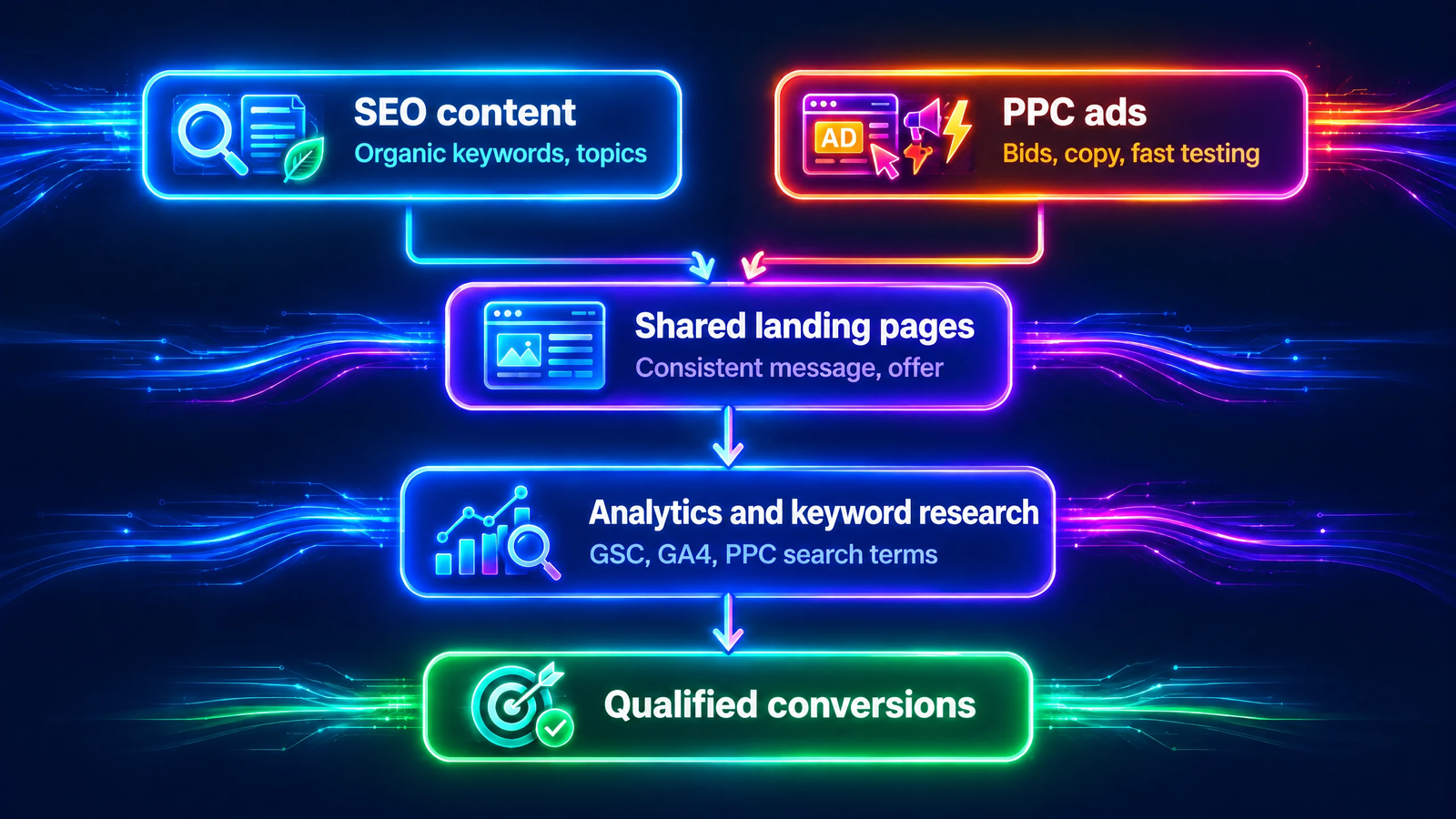
Mistake: Treating SEO and paid ads as competitors instead of teammates. Paid data tells you which keywords convert; that data should directly inform your SEO content priorities. Fix: use paid search data to decide what to write organic content about next.
Mistake: No attribution model. If you can’t say which channel actually drove a sale, you’re optimizing based on vibes. Fix: set up basic UTM tracking and conversion tagging before you spend a dollar on ads.
9. How to Build a Digital Marketing Strategy in 7 Steps
Use this as a working checklist, not a theoretical framework.
- ☐ Define one primary goal — leads, sales, or awareness. Not all three at once.
- ☐ Identify your audience specifically — not “everyone who might want this,” but a named persona with real pain points.
- ☐ Set a realistic budget — as a rough benchmark, most small businesses allocate 7–12% of revenue to marketing. See our pricing plans for a sense of what different budget tiers actually get you.
- ☐ Choose 2–3 channels max to start — based on where your specific audience already spends time.
- ☐ Build a content calendar — even a simple spreadsheet beats no plan at all.
- ☐ Launch and track weekly — not monthly. Weekly catches problems before they burn real budget.
- ☐ Optimize based on data, not opinion — kill what isn’t working within 2–3 weeks; double down on what is.
If you’d rather have someone execute this framework than build it yourself, that’s exactly the gap a specialized digital marketing agency fills — more on that trade-off below, or you can get in touch with Adzine directly.
10. Digital Marketing Tools Compared
| Tool | Best For | Starting Price | Key Limitation |
|---|---|---|---|
| HubSpot | All-in-one CRM + marketing automation | Free tier; paid plans scale up quickly | Gets expensive fast as contact lists grow |
| Salesforce Marketing Cloud | Enterprise-scale personalization | Custom/enterprise pricing | Steep learning curve, needs dedicated admin |
| Mailchimp | Small business email marketing | Free tier; low-cost paid plans | Automation features are basic compared to enterprise tools |
| Google Analytics 4 | Free traffic and conversion tracking | Free | Reporting interface has a real learning curve |
No tool fixes a bad strategy. Pick the simplest one that does what your current stage of business actually needs, and upgrade when you outgrow it — not before.
11. Agency vs. In-House: Which One Fits You?
| Factor | Agency | In-House Team |
|---|---|---|
| Cost | Lower upfront, ongoing retainer | Higher upfront (salaries, benefits) |
| Speed to launch | Fast — existing processes and tools | Slower — hiring and onboarding time |
| Breadth of expertise | Wide — specialists across channels | Narrow unless you hire multiple specialists |
| Control & institutional knowledge | Lower — external partner | Higher — embedded in your business |
The honest rule of thumb: if you need broad expertise across several channels and don’t have the budget for five specialists, an agency is almost always more cost-efficient. If your marketing needs are narrow but deep — one channel, done extremely well, forever — an in-house hire can pay for itself faster. If you want to see how this looks in practice, browse Adzine’s recent projects or check our pricing tiers.
12. Expert Tips
Tip: Don’t judge a channel’s performance before it’s had a fair sample size. SEO needs months; even PPC needs at least a few hundred clicks per ad variant before the data means anything.
Tip: Your best-performing organic social post is a research goldmine — it’s telling you exactly what message resonates. Turn it into an ad before you brainstorm a new concept from scratch.
Tip: Build your email list before you need it. The worst time to start collecting emails is the week you actually need a sale.
Tip: In 2026, structure content so a single section fully answers one question — AI systems like Google AI Overviews, ChatGPT, and Perplexity increasingly pull self-contained answer blocks, not full articles. Read more in our 2026 trends guide.
13. FAQs
What are the 4 main types of digital marketing?
Most marketers group the essentials into SEO, paid advertising (PPC), social media marketing, and email marketing — though a complete strategy usually also includes content marketing and marketing automation.
Is digital marketing a good career in 2026?
Yes, particularly for specialists in SEO and paid media, where demand consistently outpaces the supply of people who can prove real results, not just certifications.
How much does digital marketing cost for a small business?
Most small businesses spend between 7% and 12% of revenue on marketing, though a business can start testing digital channels with a budget as small as a few hundred dollars a month.
What’s the difference between digital marketing and online marketing?
Digital marketing is the umbrella term covering any digital channel, connected or not; online marketing specifically refers to channels that require an internet connection, like SEO and email.
What skills do I need to start in digital marketing?
Basic analytics literacy, comfort with at least one ad platform, fundamental copywriting, and a working understanding of SEO will cover the majority of entry-level roles.
How long does it take to see results from digital marketing?
Paid channels can show data within days; SEO and content marketing typically take four to six months to show meaningful, compounding traffic.
Can I do digital marketing without a degree?
Yes. Employers in this field weight demonstrable results and portfolio work more heavily than formal degrees, which is part of why certifications from Google and HubSpot carry real weight.
Conclusion
The businesses that win at digital marketing aren’t running every channel at once. They’re the ones who understand their audience well enough to pick two or three channels that actually match how that audience buys, fund those channels properly, and adjust based on data instead of guesswork. Everything in this guide — the channel breakdowns, the cost tables, the mistakes to avoid — exists to help you make that call with real numbers instead of a trend you saw on LinkedIn.
Great article! The information about digital marketing services was clear and very helpful. Thanks for sharing!
Thanks a lot! Glad it helped. 🙌
Nice Information,Thanks for sharing!