If you are comparing SEO vs PPC, you are probably trying to answer a practical question: where should the next rupee of your marketing budget go?
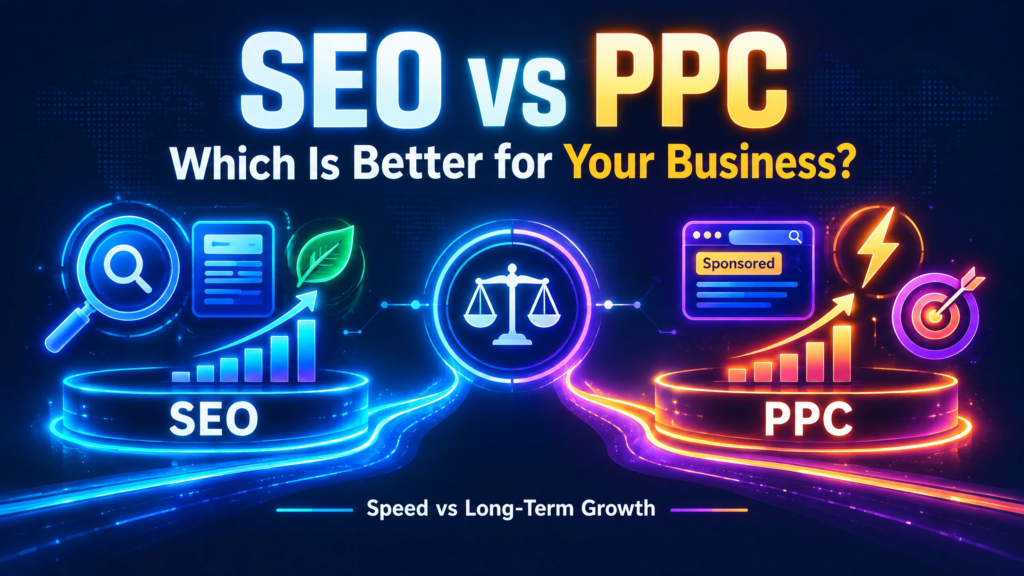
The honest answer is that there is no single winner. SEO and PPC solve different problems. PPC can help you get visibility and leads quickly. SEO can build a steady source of traffic that continues to work after the first piece of content is published. The right choice depends on your timeline, budget, competition, product, and business goals.
This guide explains the difference in simple language. It also gives you a clear way to decide whether to start with SEO, PPC, or both. For a wider overview, read our guide to digital marketing strategy.
Quick answer: SEO or PPC?
Choose PPC first when you need traffic, leads, or sales soon. This is especially useful for a new offer, a product launch, a seasonal promotion, or a business that cannot wait several months to build organic visibility.
Choose SEO first when you are building a long-term marketing asset. SEO is a strong option when people regularly search for your products or services and you are willing to invest in useful content, website improvements, and consistent work.
Choose both when you can support both channels. PPC gives you speed and quick feedback. SEO builds a more durable source of demand. Together, they can reduce the pressure on any one channel.
Simple rule: PPC is usually better for immediate demand. SEO is usually better for building lasting visibility.
What is SEO?
SEO, or search engine optimization, is the process of improving a website so that search engines can understand it and people can find it through unpaid search results. It includes useful content, clear website structure, technical improvements, internal links, and credible references from other websites.
SEO does not mean adding keywords everywhere. Modern SEO is mainly about answering real questions clearly and making the website easy to crawl, understand, and use. Google’s official SEO Starter Guide also focuses on helping search engines discover, understand, and present useful content.1
SEO usually needs patience. A new website may take months to build authority and earn meaningful rankings, especially in a competitive market. However, a good page can continue bringing visitors long after it is published.
What is PPC?
PPC, or pay-per-click advertising, is a paid advertising model in which you pay when someone clicks on your ad. Search ads can appear when people look for specific keywords. Display, social, and video campaigns can reach people based on audiences, interests, locations, behavior, or previous visits to your website.
PPC gives you more control over the message, landing page, audience, location, timing, and budget. You can normally start a campaign quickly and see early data. Google’s official Google Ads guide explains how paid campaigns connect ads with relevant searches and measure performance. If you need help with campaign planning, explore our Google Ads and PPC services.
The main limitation is simple: when the budget stops, the paid traffic usually stops too. That does not make PPC bad. It means PPC should be managed as an active growth channel, not treated as a permanent replacement for a strong website.
SEO vs PPC at a glance
| Factor | SEO | PPC |
|---|---|---|
| Time to first useful results | Usually slower; often measured in months | Usually fast; campaigns can begin generating data soon after launch |
| Cost structure | Investment in content, people, tools, and technical work | Ongoing spend for clicks, impressions, or conversions |
| Traffic after spending stops | Some pages may continue receiving organic traffic | Traffic generally falls when campaigns are paused |
| Control over message | Limited by search results and page rankings | High control over ad copy, audience, timing, and landing page |
| Long-term value | Can compound as content and authority grow | Must be funded and optimized continuously |
| Testing speed | Slower feedback loop | Faster feedback on offers, keywords, and audiences |
| Trust and user behavior | Many users prefer unpaid results | Some users skip ads, while others click them because they are prominent |
| Best use | Building visibility and demand over time | Capturing demand now and testing what converts |
| Main risk | Slow progress or poor results from weak strategy | Paying for clicks that do not become qualified leads or customers |
The traffic difference: fast results versus compounding growth
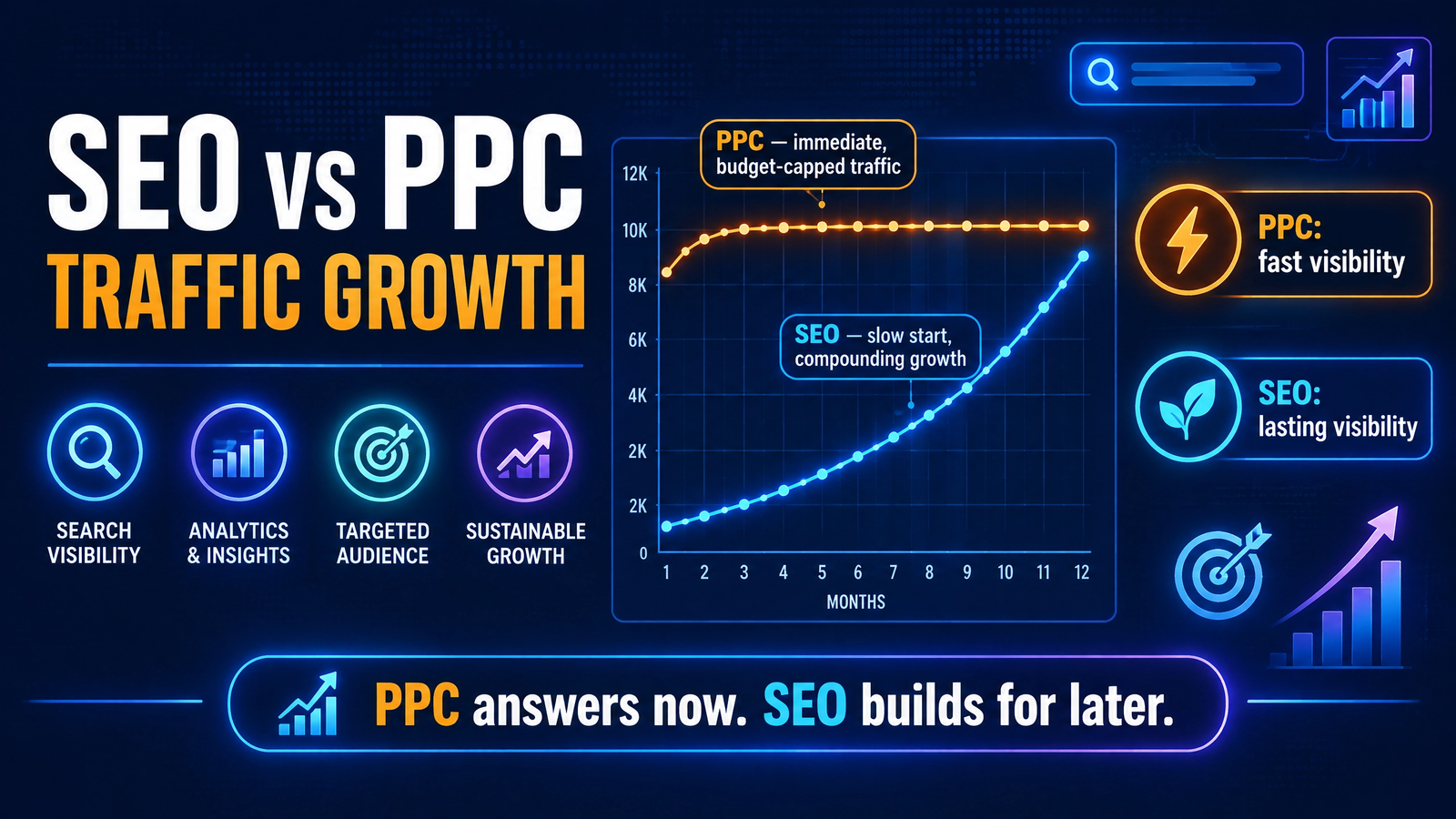
The chart below is an illustrative model, not a promise of performance. It shows the usual pattern: PPC can create immediate traffic, while SEO may start slowly and grow as more useful pages earn visibility.
What the chart means
PPC is like turning on a tap. You can increase traffic by increasing the budget, improving the campaign, or expanding the audience. You can also turn it off quickly.
SEO is more like building a library. One page may not change the business immediately. Over time, however, a useful collection of pages can rank for many related searches and bring visitors from different parts of the buying journey.
This is why it is not fair to compare SEO and PPC only by looking at the first week. It is also not fair to compare them only by looking at a three-year period. The time horizon changes the answer.
When PPC is the better first choice
PPC is often the better starting point when speed matters more than long-term efficiency.
You need leads or sales in the next 30 days
If your business has an urgent revenue target, waiting for organic rankings may not be practical. A well-structured PPC campaign can put a relevant offer in front of people who are already searching or who match your target audience.
You are launching a product or testing an offer
Paid campaigns can help you test headlines, prices, landing pages, audiences, and calls to action. The data is not automatically perfect, but it can help you learn faster than waiting for an SEO page to rank.
You operate in a very competitive search market
Some markets have strong websites, large brands, and years of accumulated authority. SEO may still be valuable, but it may take longer to produce meaningful results. PPC can help you compete for visibility while your organic strategy develops.
You need detailed targeting
PPC platforms can provide targeting options that organic search does not offer in the same way. Depending on the platform and campaign type, you may be able to target by location, device, time, audience signals, or previous interaction with your brand.
You have a seasonal or time-sensitive offer
A festival sale, event, limited-time service, or end-of-season promotion may not wait for an SEO strategy to mature. PPC can help you reach people during the period when the offer matters most.
When SEO is the better first choice
SEO is often the better starting point when you want to build a durable source of demand.
You are building a business, not just a campaign
A strong SEO page can become an asset. It may educate buyers, answer objections, support sales conversations, and bring visitors months after publication. It still needs maintenance, but its value does not disappear the moment a daily ad budget is paused.
Your customers research before buying
SEO works well when people search for comparisons, explanations, pricing information, problems, reviews, and how-to guidance before making a decision. Helpful content can meet them at each stage of that research process.
Your paid acquisition cost is increasing
If each new customer from paid advertising is becoming more expensive, SEO can help diversify your acquisition mix. It will not remove the need for paid marketing, but it can reduce dependence on constantly increasing bids and budgets.
Your business has stable search demand
SEO is easier to justify when people consistently search for the problem your business solves. Before investing, check whether the searches are relevant, whether the intent is commercial, and whether your business can create a better answer than the pages already ranking.
You want to build brand trust
A useful organic presence can make a business easier to discover and easier to trust. That trust does not come from ranking alone. It comes from accurate information, a clear brand, genuine expertise, good user experience, and proof that the business can deliver.
The smartest option for many businesses: use both
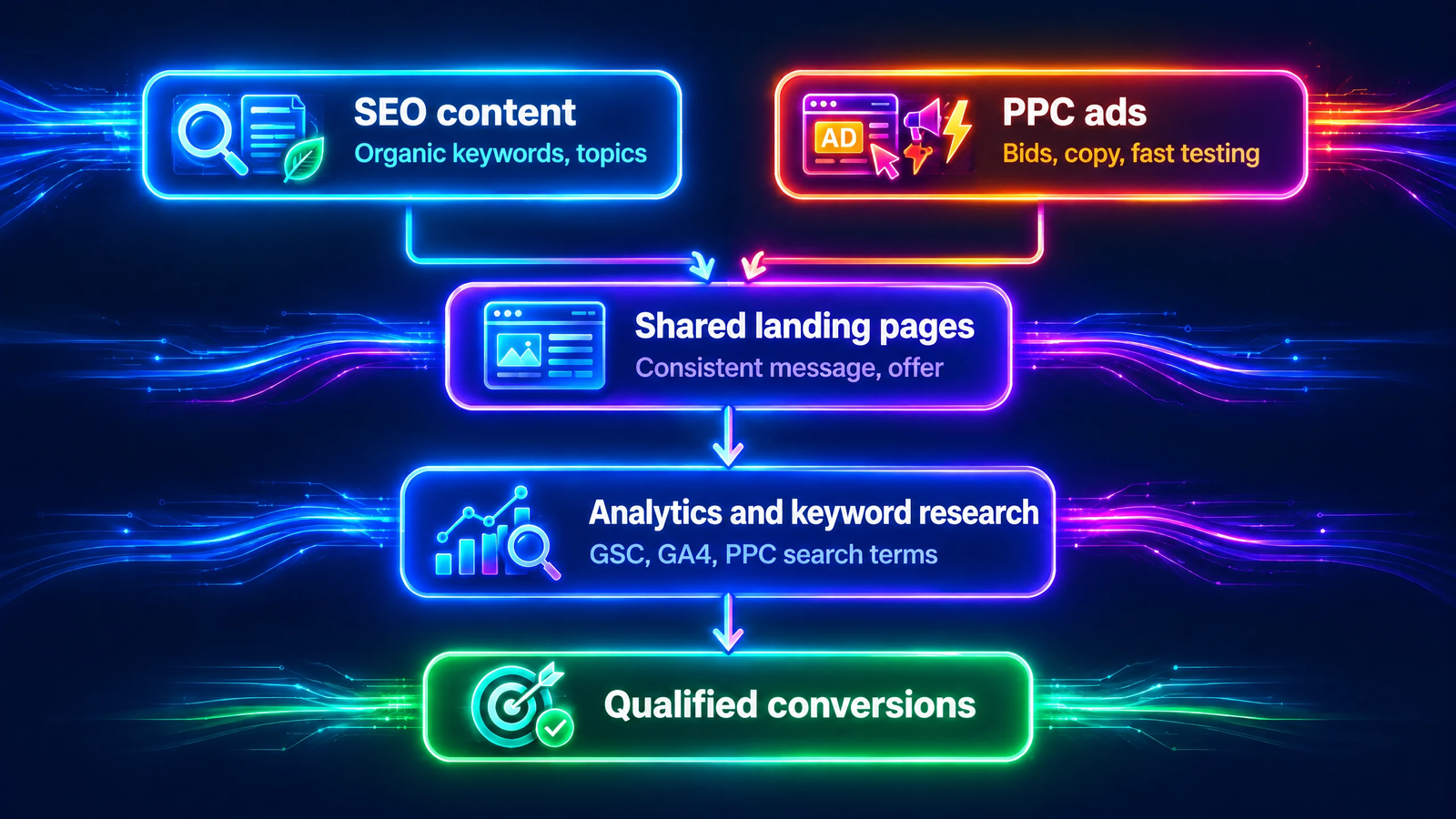
SEO and PPC can support each other when they are managed as one customer-acquisition system.
PPC can reveal which search terms produce qualified leads. Those insights can guide SEO topics and landing pages. PPC can also help you test a new message before investing heavily in a long-form content strategy.
SEO can reduce the amount of paid traffic you need for informational searches. It can also help people who click an ad but want to research the company before contacting it. A strong organic presence gives those people more useful places to learn.
The goal is not to make every visitor come from SEO or every sale come from PPC. The goal is to create a healthy mix that produces profitable customers without making the business dependent on one traffic source.
A simple decision framework
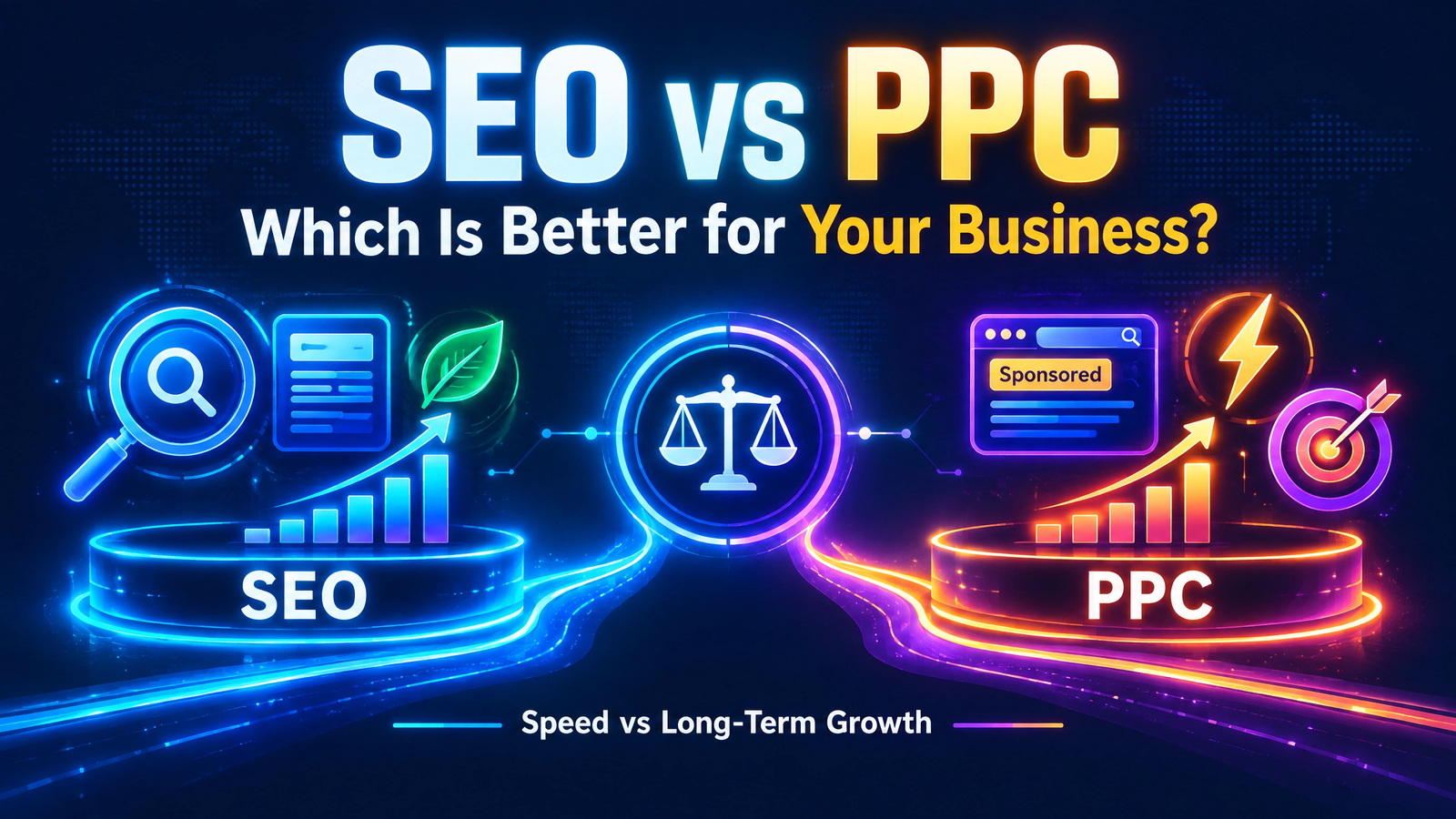
Use the framework below when deciding where to invest first.
Step 1: Define the time horizon
Ask what the business needs in the next 30, 90, and 365 days. If the immediate target is urgent revenue, PPC may deserve more attention now. If the target is lower acquisition cost and stronger visibility over the next year, SEO needs a meaningful place in the plan.
Step 2: Check the search demand
Look at the words people use when they search for your product or service. Separate informational searches from buying-intent searches. A large search volume is not enough if the people searching are not your customers.
Step 3: Calculate the economics
Do not compare SEO and PPC by clicks alone. Compare them using business outcomes such as qualified leads, sales, gross profit, customer acquisition cost, and payback period.
For PPC, include ad spend, agency or staff time, landing page costs, and conversion tracking. For SEO, include strategy, writing, editing, technical work, link development, tools, and content maintenance.
Step 4: Measure the quality of the conversion
A cheap lead is not always a good lead. Track whether leads are reachable, suitable, sales-qualified, and likely to become customers. A channel that produces fewer but better customers may be more valuable than one that produces many low-quality enquiries.
Step 5: Review the mix every 90 days
Marketing conditions change. Competitors change their bids and content. Search behavior changes. Your landing pages improve. Review performance regularly and move budget toward the channels that create profitable business results.
Common mistakes businesses make
Mistake 1: Treating SEO as free traffic
SEO traffic does not have a per-click bill, but SEO is not free. It needs strategy, research, writing, technical support, design, measurement, and maintenance. The cost is often less visible than an advertising invoice.
Mistake 2: Treating PPC as guaranteed sales
PPC can bring visitors quickly, but clicks are not customers. Poor targeting, weak ad copy, slow pages, unclear offers, and weak follow-up can waste a budget.
Mistake 3: Measuring SEO too early
A new article may need time to be crawled, indexed, improved, and trusted. Short-term traffic numbers can be useful, but they should not be the only measure of progress. Look at ranking movement, relevant impressions, qualified traffic, assisted conversions, and revenue over a sensible period.
Mistake 4: Sending every ad to the homepage
A person searching for one specific solution should usually land on a page that directly addresses that solution. A focused landing page often makes the next step clearer than a general homepage.
Mistake 5: Ignoring conversion tracking
Without reliable tracking, you cannot know whether a channel is working. Set up meaningful events, such as form submissions, phone calls, purchases, booked meetings, or qualified enquiries. Then connect those actions to actual business outcomes where possible.
Mistake 6: Choosing a channel because it feels cheaper
SEO can feel cheap because its costs are spread across time. PPC can feel expensive because the spend is visible every day. Use a 12-month view and compare customer acquisition cost, conversion quality, revenue, and profit.
How to divide a limited budget
There is no universal percentage that works for every business. A practical starting point is to match the split to the business stage.
| Business situation | Possible starting emphasis | Why |
|---|---|---|
| New offer with urgent sales target | More PPC, with basic SEO foundations | Generate data and demand quickly while building the base |
| Established business with rising ad costs | Balanced SEO and PPC | Protect immediate revenue while improving long-term efficiency |
| Content-led business with stable demand | More SEO, selective PPC | Build organic authority and use ads for high-value opportunities |
| Seasonal business | PPC during demand peaks, SEO year-round | Capture urgent demand while building future visibility |
| Very small budget | One focused PPC campaign plus foundational SEO | Avoid spreading resources across too many channels |
These are planning directions, not fixed rules. Your customer lifetime value, margins, sales cycle, competition, and conversion rate should determine the final budget.
What should you measure?
For SEO, track qualified organic traffic, impressions for important topics, rankings for commercially relevant searches, leads, assisted conversions, and revenue influenced by organic visits.
For PPC, track impression share where relevant, click-through rate, cost per click, conversion rate, cost per qualified lead, customer acquisition cost, and revenue or profit generated. Do not optimize only for the cheapest click.
The most useful question is not, “Which channel got more traffic?” It is, “Which channel helped us acquire the right customers at a sustainable cost?”
Final verdict: SEO vs PPC is not an either-or decision
If you need immediate visibility, start with PPC. If you want a long-term traffic and trust asset, invest in SEO. If the business can support both, use PPC for speed and learning while SEO builds durable visibility.
The best strategy is usually not to choose a permanent winner. It is to choose the right sequence.
Start with the business timeline. Match the channel to the job. Measure leads and customers instead of vanity metrics. Review the results every 90 days. Over time, the strongest marketing systems usually combine paid and organic visibility rather than depending entirely on one.
Need help deciding where your budget should go? A marketing audit can compare your current customer acquisition cost, organic visibility, conversion performance, and competitive gap before you commit more spend.
Related internal links
- Adzine digital marketing strategy guide
- Adzine SEO, Google Ads and PPC services
- More SEO and PPC marketing tips on the Adzine Blog
- Adzine portfolio of SEO and digital marketing projects
Nice Information 👍